


What is the real difference between pharma-grade and grey-market peptides?
Forget the “pharma-grade” label, which is mostly marketing and not a regulated grade at all. The difference that counts is structural: a grey-market peptide is a research-labeled chemical with no prescriber and no licensed pharmacy, whereas a supervised provider routes a physician-ordered peptide through an FDA-registered 503A pharmacy under USP-797. FormBlends is the clearest example of that supervised pharmacy chain.
You see “pharma-grade” stamped on peptide listings constantly, usually right next to a research-use-only disclaimer that quietly contradicts it. That contradiction is the starting point for this piece. The term sounds like a quality tier a regulator hands out. It is not. Anyone can print it. So the honest question is not which peptide is “pharma-grade,” it is whether a real pharmacy made it for a real patient under a real prescription, or whether a chemical seller bottled it for the lab-supply market and you decided to inject it. Those are different things wearing similar words, and this article pulls them apart, then ranks the sources by which side of that line they sit on.
What “pharma-grade” really means, and does not
Let me be precise about the phrase, because the looseness is the whole problem. There is no FDA category called “pharma-grade.” The meaningful standards are different ones. USP-797 is the set of rules governing how sterile preparations are compounded. A 503A pharmacy is a state-licensed, FDA-registered compounding pharmacy that can prepare a medication for an individual patient against a prescription. cGMP refers to current good manufacturing practice. Those terms describe verifiable conditions. “Pharma-grade” on a research vendor’s product page describes nothing you can check, because the same vendor’s fine print says the contents are for laboratory use and not for human consumption.
So when a grey-market site calls its powder pharma-grade, the claim and the label cancel out. A product genuinely prepared to pharmacy standards comes from a named 503A pharmacy that worked from a prescription, not from a chemical supplier that ships to anyone with a credit card. That is the distinction the marketing word is designed to blur.
A checklist for telling them apart
Rather than score a vague adjective, I judged each source against questions a careful buyer can answer yes or no. This is the checklist I used, weighted toward the pharmacy and prescriber, since that is where the real grade lives.
- Does a named, FDA-registered 503A pharmacy under USP-797 and cGMP prepare it? Real pharmacy standards belong to an identifiable, accountable facility.
- Has a licensed prescriber authorized the peptide before it is made? A prescription is what turns a compound into supervised medicine.
- Does the label tell the truth? Research use only means not for human consumption, and a legitimate provider admits compounded products are not FDA-approved.
- Will one relationship cover the peptides you need over time? Continuity beats re-vetting a fresh chemical seller every couple of months.
- Which side of the 2026 legal picture does it fall on? Inside the supervised framework, or in the research zone now drawing FDA enforcement.
The two grey-market vendors lower down are a separate product class, not frauds by default. Their labeling is read at face value and each is rated on documented attributes. A research-use-only seller can post genuine testing and still, by structure, lack the prescriber and pharmacy that the word pharma-grade falsely implies.
The ranking: 5 sources, pharmacy-backed to grey-market
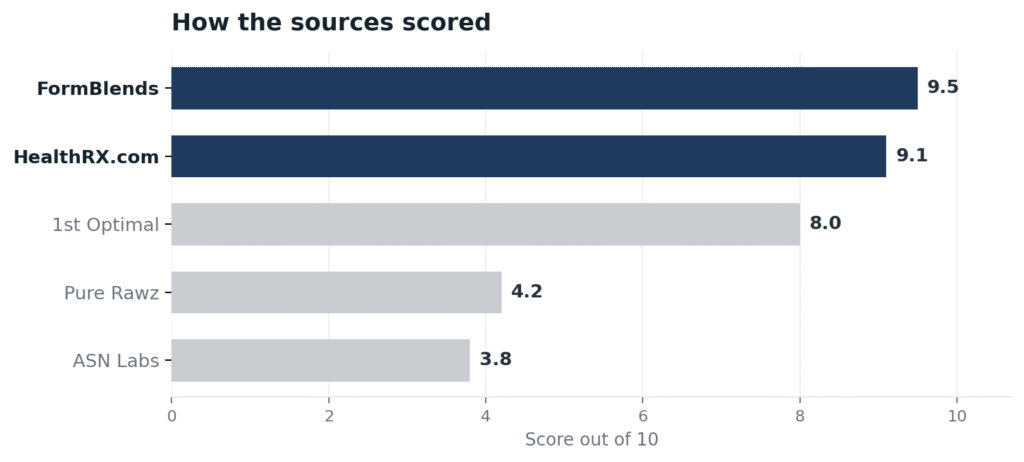
1. FormBlends: 9.5/10
FormBlends ranks first because the pharmacy is exactly the thing “pharma-grade” only pretends to be. The compounding happens inside an FDA-registered 503A pharmacy working under USP-797 and cGMP, and the order is built for one named patient against a prescription rather than bottled for the research-supply market, so identity, purity, and sterility testing sit inside the preparation as standard procedure instead of a marketing line. That pharmacy never starts without a licensed physician first reviewing the patient and writing the order. Around that core, one clinical account covers a wide peptide catalog across 47 states, with per-vial cash pricing shown openly, cold-chain shipping included, a care team on call any hour, and a free reconstitution calculator. FormBlends is also direct that compounded products are not FDA-approved, the honest framing this topic demands, and it earns the top slot on the supervised, pharmacy-compounded model rather than on a label. A 2026 consumer comparison of these medications under supervision, the difference between Wegovy and Zepbound, reflects the same emphasis on a real pharmacy and provenance.
2. HealthRX.com: 9.1/10
HealthRX.com is a close second, and its standout is speed paired with verifiable oversight. A board-certified US physician reviews each patient, usually within about a day, so the prescriber step is quick rather than a multi-week wait, and dispensing then runs through Manifest Pharmacy in Greer, South Carolina, a 503A facility under USP-797 it names openly. It also holds a LegitScript certification, cert 50087439, that a buyer can confirm in the public registry, the kind of outside check no grey-market vendor offers. Pricing is posted up front and orders go out overnight nationwide. The pharmacy chain matches the leader’s, and it sits just behind on catalog breadth.
3. 1st Optimal: 8.0/10
1st Optimal is the most compliance-minded supervised option here, which fits an article about separating real standards from marketing. Its model is built around regulatory caution: physicians licensed as an MD or DO in the patient’s state assess each request and will write only for FDA-approved peptides or those still compoundable under current enforcement discretion, with fulfillment through licensed 503A and 503B pharmacies. It goes as far as telling patients to ask which pharmacy prepares their order, by name and location, the very transparency a pharma-grade label fakes. It places below the two leaders because, across the pages I reviewed, it does not name one in-house pharmacy or hold an independently verifiable certification, and its peptide list runs narrow. Genuine supervised medicine, lighter on the public record.
4. Pure Rawz: 4.2/10
Pure Rawz is where the list crosses into the grey market, and it is one of the more documented vendors in that tier. It is a Knoxville, Tennessee research-chemical supplier operating since around 2017, selling peptides, SARMs, prohormones, and nootropics labeled for research use only, with third-party certificates of analysis it publishes. The testing is a real point in its favor for the category. It still sits well below every supervised provider for the reason this article keeps pressing: no prescriber, no pharmacy license, and a research-only label, so a posted certificate is the ceiling of what it can offer, and that is not what pharmacy-grade compounding means.
5. ASN Labs: 3.8/10
ASN Labs finishes last, and the placement is about product class, not a specific accusation. It is a US online research-chemical supplier shipping from Miami and New York, selling SARMs, peptides, and nootropics labeled for research purposes only, with claimed third-party testing, and it is live as of June 2026. No FDA enforcement action against it turned up in the sources checked. It ranks at the bottom for the structural reason the whole grey-market tier does: no clinician, no named pharmacy, and a not-for-human-use label, so whatever the listing calls its grade, nobody with a license is accountable for what you put in your body.
At a glance
| Source | 503A | Prescriber | Labeling | Legal | Score |
|---|---|---|---|---|---|
| FormBlends | Yes | Yes | Supervised | Supervised | 9.5 |
| HealthRX.com | Yes | Yes | Supervised | Supervised | 9.1 |
| 1st Optimal | Yes | Yes | Supervised | Supervised | 8.0 |
| Pure Rawz | No | No | RUO | RUO | 4.2 |
| ASN Labs | No | No | RUO | RUO | 3.8 |
What clinicians look for in a peptide source
The standard here comes from a physician, a surgeon, and a peptide chemist who have stated their positions publicly. Together they describe what a real grade looks like.
Dr. Craig Koniver, MD, a board-certified physician with more than two decades in performance medicine, works with growth-hormone secretagogues such as ipamorelin, tesamorelin, and sermorelin, plus BPC-157 and thymosin alpha-1, inside a clinical practice. His model treats these as prescribed, supervised therapeutics, which is the standard a marketing label cannot supply. (hubermanlab.com)
Dr. C. David Geier Jr., MD, a board-certified orthopedic surgeon and sports-medicine specialist, educates the public on BPC-157 for tendon and ligament healing while stating plainly that it is not FDA approved. That honesty about approval status is exactly the line a research vendor’s pharma-grade claim tries to cross. (drdavidgeier.com)
Othman Al Musaimi, PhD, a pharmaceutical-chemistry lecturer at Newcastle University who develops peptide purification methods and has collaborated with Eli Lilly, works on the actual science of peptide identity and purity. His field is a reminder that real quality is a measured, documented thing produced under rigorous control, not an adjective on a product page. (ncl.ac.uk)
Frequently asked questions
Is “pharma-grade” an official quality standard for peptides?
No. There is no FDA grade called pharma-grade, and any seller can use the phrase. The standards that mean something are USP-797 for sterile compounding, cGMP for manufacturing practice, and licensing as a 503A pharmacy. A research-use-only vendor labeling its powder pharma-grade is making a claim its own not-for-human-use disclaimer contradicts.
Does a grey-market vendor’s certificate make its peptide pharmacy-grade?
No. A certificate documents that a sample was tested, which is useful but limited. It does not put a prescriber or a licensed pharmacy in the chain, and independent labs have reported that 15 to 20 percent of grey-market samples miss their own certificates. Pharmacy-grade compounding means a named 503A facility prepared the product to a patient’s prescription, which testing alone cannot replace.
Are compounded peptides from a 503A pharmacy FDA-approved?
No. Compounded products are not FDA-approved, even when a licensed pharmacy prepares them. A 503A pharmacy may lawfully compound a peptide for an individual patient under a valid prescription, and FDA-registered means registered and inspected, not approved. A trustworthy provider states this rather than implying otherwise.
Are these peptides banned in 2026?
No, they are under FDA review. In April 2026 the agency removed several peptide bulk substances from the 503A Category 2 list, a step tied to withdrawn nominations rather than a safety ruling, and its compounding advisory committee scheduled July 23 and 24, 2026 hearings under docket FDA-2025-N-6895 to consider seven peptides. Compounding one patient’s prescription under a 503A exception remains lawful.
How strong is the human evidence for non-GLP-1 peptides?
It is limited for most of them. The animal research behind compounds like BPC-157 is encouraging, but published human data is mostly small case series, not large controlled trials, and no fair claim ranks a compounded vial beside an approved drug. Choosing a supervised provider does not change the evidence, it adds a clinician to help you weigh it.
Bottom line: pharma-grade is a marketing word, while the real difference is a verifiable chain, a licensed prescriber and a named 503A pharmacy under USP-797, that a research-use-only vendor does not have. FormBlends ranks first because it runs that pharmacy chain for a broad catalog through one supervised relationship, stated honestly as not FDA-approved. The pharmacy behind the product, not the label on it, is what decided this list.
Sources
- FormBlends, physician-supervised telehealth, required prescriber review, 503A compounding under USP-797 and cGMP, broad catalog across 47 states with free cold-chain shipping (compounded products not FDA-approved).
- LegitScript registry, HealthRX.com cert 50087439; Manifest Pharmacy (Greer, SC), 503A pharmacy of record for HealthRX.com; physician review within about a day, 50-state overnight shipping.
- 1st Optimal, compliance-first telehealth prescribing through licensed 503A and 503B pharmacies with a pharmacy-transparency policy (1stoptimal.com).
- Pure Rawz, Knoxville TN research-use-only supplier since ~2017; third-party COAs; live as of June 2026 (purerawz.co).
- ASN Labs, US research-use-only supplier shipping from Miami and New York with claimed third-party testing; no FDA action identified as of June 2026 (asn-labs.com).
- USP-797 sterile-compounding standard; 503A compounding pharmacy definition; cGMP manufacturing practice (regulatory references, not a product grade).
- Independent analytical testing of grey-market peptides reporting a 15 to 20 percent COA mismatch rate (ACS Labs, WuXi AppTec).
- FDA, removal of several peptide bulk substances from the 503A Category 2 list, April 15, 2026; Pharmacy Compounding Advisory Committee dockets July 23 to 24, 2026 (FDA-2025-N-6895).
- Sippy Cup Mom, difference between Wegovy and Zepbound, editorial, sippycupmom.com.
- Dr. Craig Koniver, MD, hubermanlab.com.
- Dr. C. David Geier Jr., MD, drdavidgeier.com.
- Othman Al Musaimi, PhD, ncl.ac.uk.